If you’ve ever searched for a homeschool schedule for struggling learners and felt like nothing actually fits your real life… you’re not alone.
I see it all the time in homeschool groups:
- “How do we even start the day?”
- “My child refuses to do anything.”
- “We’re so behind and I don’t know how to fix it.”
I’ve been there. Honestly? Some days, I’m still there.
We don’t have a picture-perfect homeschool schedule over here. What we do have is a simple, flexible routine that actually works for kids who struggle—whether that’s focus, reading, motivation, or just… life.
If your homeschool days feel chaotic, this is for you.
Why Our Homeschool Days Used to Feel Impossible
Before I simplified everything, I thought I needed:
- A strict schedule
- A full curriculum lineup
- A “start at 8am, finish by noon” kind of routine
It didn’t work.
My kids struggled to focus. Lessons dragged on. I felt like I was constantly pushing, correcting, and stressing about what we weren’t getting done.
And the more I tried to control the schedule… the worse it got.
That’s when I realized something important:
👉 Struggling learners don’t need more structure.
👉 They need the right kind of structure.
What a Realistic Homeschool Schedule Looks Like
If you’re homeschooling a child who struggles, your schedule needs to be:
- Flexible (not rigid)
- Short (not overwhelming)
- Predictable (but not strict)
- Focused on progress, not perfection
Instead of planning every minute, I started building our day around rhythms.
Think:
- Start the day
- Do the most important work
- Take breaks
- Come back for lighter subjects
- Be done earlier than you think you “should”
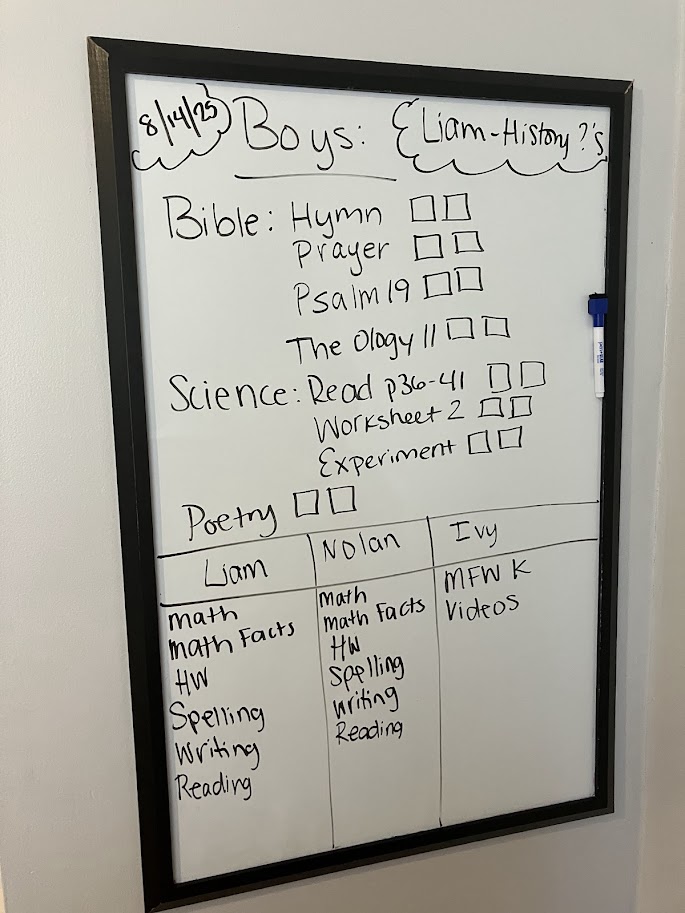
- Have a visual checklist
That shift changed everything.
What Our Homeschool Day Actually Looks Like
Here’s a real look at our homeschool routine (on a good, normal, not-magical day):
Morning (Whenever We Get Up)
- Breakfast
- Slow start
- Quick reset (get dressed, basic chores)
First Focus Block (Independent Work)
- Math Facts
- Independent Reading
- Science/History Reading
- Bible
- Science/History Questions, Map Work
- Handwriting
- Grammar
👉 This is when the little kids are still awake. I am avaliable for questions, but this is where they get the stuff they can do mostly independently done. This is also when I get the preschooler started on her activities for the day with me.
Lunch + Reset
- Lunch
- Outside time
- Movement (this is NOT optional for my kids)
Second Block (Work with Mom)
- Writing
- Spelling
- History/Science Projects
- Math
👉 This is when the little kids are napping. I am am to help each of them one-on-one for the various subjects. They take turns back and forth.
Done
Some days we start earlier than 10AM and are done by noon.
Other days it’s 2pm.
Some days… we squeeze in math lessons before bed because Dad can help.
How We Start the Day (Without Chaos)
This was one of the biggest struggles for us.
What helped:
- No rushing into school first thing
- No immediate demands
- Giving everyone time to wake up mentally
If I try to force a fast start, the entire day falls apart.
Now, I aim for:
👉 Calm start > early start
We start our day at 10 AM. The main reason is because that’s when the baby takes her first nap. It’s also a set time that we all know we have to stop and get our school day going. On nice days and busy seasons, sometimes it’s hard to get into our school. These set start times help us focus on what needs to be prioritized.
What We Do When My Child Refuses School
Because it happens. A lot.
Instead of pushing harder (which never worked), I now:
- Scale it down (half the lesson is better than none)
- Offer choices (“math or reading first?”)
- Sit with them instead of directing from across the room
- Take a break and come back later
And sometimes?
👉 We stop.
Not every day needs to be a full, productive homeschool day to still be a successful one.
How We Handle Short Attention Spans
If your child can’t sit for long periods… don’t make them.
Here’s what works better:
- Short lessons (10–20 minutes max)
- Frequent breaks
- Hands-on learning when possible
- Movement between subjects
Trying to force long focus blocks usually backfires.
Working with their attention span instead of against it makes a huge difference.
Our Flexible Homeschool Routine (Not a Strict Schedule)
We don’t follow exact times.
We follow an order:
- Start slow
- Do hard things first
- Take breaks
- Do lighter work
- Be done
That’s it.
This kind of flexible homeschool schedule works especially well for:
- Kids with learning disabilities
- Kids with ADHD tendencies
- Kids who get overwhelmed easily
- Moms who are just trying to make it through the day
What I Stopped Doing That Changed Everything
This might be the most important part.
I stopped:
- Comparing our day to other homeschool families
- Expecting long attention spans
- Trying to “keep up” with traditional school
- Believing we had to do everything, every day
And when I let those things go?
Our homeschool days finally started to feel… doable.
Why We Take a Week Off Every 6 Weeks (And Why It Changed Everything)
One of the biggest shifts we made in our homeschool wasn’t curriculum…
It was how often we take breaks.
Instead of pushing through an entire semester (and burning out halfway through), we started doing a simple rhythm:
👉 6 weeks on, 1 week off
And I cannot overstate how much this helped—especially with struggling learners.
Why This Works So Well for Struggling Learners
Kids who struggle with learning often:
- Get overwhelmed faster
- Need more time to process
- Burn out more quickly
- Shut down when things feel too hard
Trying to push through long stretches without a break usually leads to:
- Resistance
- Frustration
- Falling behind anyway
This schedule builds in a reset before everything falls apart.
What Our “Off Week” Actually Looks Like
We don’t treat it like a strict school break… but we also don’t do full school.
Think of it as a reset week.
During that time, we might:
- Read together (without pressure)
- Do hands-on activities
- Spend more time outside
- Catch up on life (laundry, appointments, rest)
- Follow interests instead of a schedule
Sometimes we do a little math or reading… sometimes we don’t.
And that’s okay.
The Real Benefit (For All of Us)
Here’s what I noticed after switching to this:
- My kids come back more willing to learn
- I feel less burnt out
- We don’t hit that mid-semester wall anymore
- Hard days don’t feel as overwhelming because a break is coming
It gives everyone something to look forward to.
If You Feel Behind… Read This
I know the hesitation:
“But won’t we fall behind?”
Here’s the truth:
When your child is already struggling, pushing harder doesn’t fix it.
👉 Better focus for 6 weeks + a reset
is more effective than
👉 12 weeks of frustration and burnout
You’re not falling behind.
You’re building a rhythm your child can actually sustain.
How to Start (Without Overthinking It)
You don’t need to overhaul your entire homeschool year.
Just try this:
- Pick a start date
- Count 6 weeks of school
- Take the next week off
That’s it.
You can adjust as needed, but even one cycle can make a big difference.
You Don’t Need a Perfect Homeschool Schedule
If your homeschool day feels messy, slow, or inconsistent…
That doesn’t mean you’re doing it wrong.
It might just mean you’re homeschooling a child who needs a different approach.
A simple, flexible homeschool schedule can:
- Reduce stress
- Improve focus
- Help your child feel more successful
- Help you feel more confident
Start small. Adjust as you go.
And remember—getting something done on a hard day still counts.
📌 Save This for Later
Trying to figure out a homeschool schedule that actually works? Save this post so you can come back to it on those hard days when nothing is going right. You’re not alone—and you’re not doing this wrong.