Starting high school can feel overwhelming for any teen, but especially for kids with ADHD, dyslexia, or executive functioning struggles. When I started planning our 9th grade curriculum this year, I knew I didn’t want to recreate public school at home.
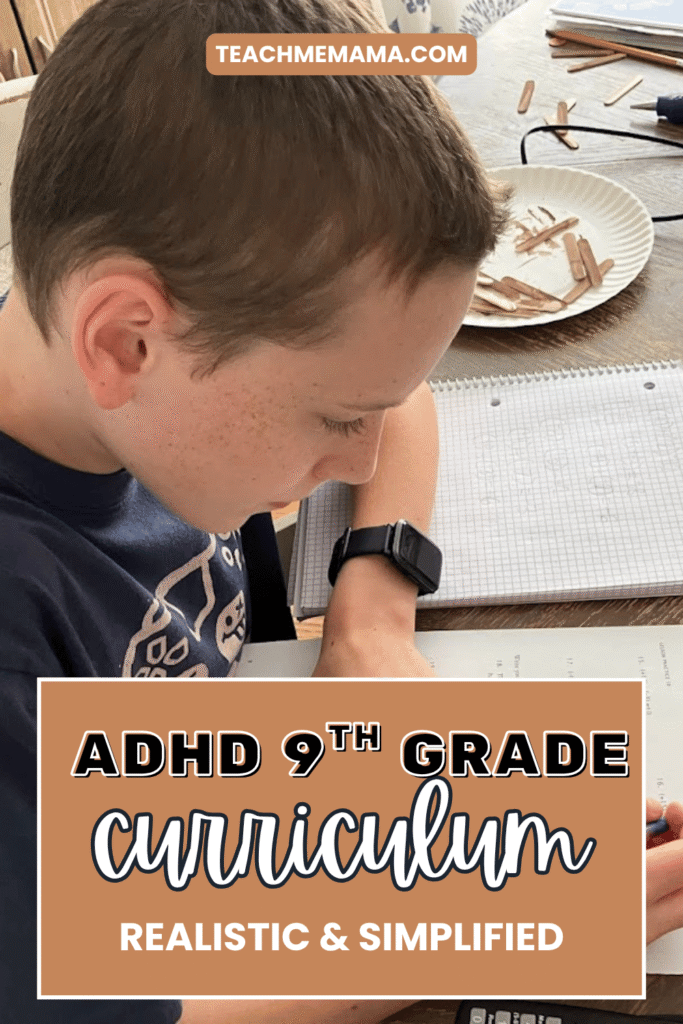
My son does not thrive with busywork, overloaded schedules, or overly rigorous programs that leave him feeling defeated before lunch.
Instead, our goal for 9th grade is simple:
- Build confidence
- Increase independence slowly
- Strengthen foundational skills
- Explore interests without pressure
- Create a peaceful transition into high school homeschooling
If you’re searching for an ADHD homeschool curriculum for a teen who struggles with traditional academics, this might give you some ideas for your own family.
Our Approach to 9th Grade Homeschooling
My son has ADHD and dyslexia, and while he’s incredibly capable, he still needs more support than many kids his age. He gets overwhelmed easily, especially when assignments feel too long, too complicated, or unclear.
He also isn’t college bound right now — and honestly, that’s okay.
At 14, he doesn’t need his entire future figured out. Right now, I care far more about helping him become a confident, capable young adult than forcing an intense academic track he isn’t ready for.
So this year, I intentionally chose a gentle 9th grade curriculum that focuses on mastery, flexibility, and real-life growth.
Our 9th Grade Curriculum Choices
Math: Success Algebra 1
Math has always been one of the biggest struggle areas for my son, especially with dyslexia and working memory challenges.
After a lot of research, we chose Denison Algebra’s Success Algebra 1 because it was specifically designed for students who struggle with traditional math programs.
What I love about it:
- Short, manageable lessons
- Video instruction
- Built-in review
- Incremental teaching
- Clear explanations
- Designed for students with learning struggles
This feels much less overwhelming than many traditional high school math programs, and that matters far more to me right now than racing through Algebra 1.
For ADHD homeschool curriculum choices, reducing frustration is often more important than increasing rigor.
Science: Guest Hollow’s Biology
Science is one of the subjects where I wanted to nurture curiosity instead of burnout.
We’re using Guest Hollow’s Biology this year, and I think it’s going to be such a good fit for him.
One of my favorite things about Guest Hollow is that it includes high-quality living books and literature alongside science instruction. My son learns far better through engaging books than dry textbooks, so this approach works beautifully for his learning style.
The flexibility is another huge plus. We can scale it up or down depending on his energy and focus levels.
>> Best Homeschool High School Biology Courses <<
Language Arts: Movies as Literature
Traditional literature analysis can feel overwhelming for my son, especially when reading itself already requires extra effort.
That’s why we’re using Movies as Literature by Kathryn Stout.
This curriculum allows him to analyze storytelling, themes, symbolism, and literary elements through movies instead of only heavy novels.
It still develops critical thinking and discussion skills while feeling far more approachable and enjoyable for him.
For teens with ADHD or dyslexia, finding ways to reduce mental fatigue can make a huge difference.
Writing: WriteShop I
We’re continuing slowly through writing instruction.
After finishing Jump In middle school writing, he’ll begin WriteShop Level 1.
Writing has never come naturally for him, so we move at a slower pace than many homeschool families — and that’s completely okay.
One thing I’ve learned homeschooling a child with ADHD is that slower progress with confidence is better than fast progress with tears.
WriteShop gives enough structure without feeling overwhelming, which is exactly what he needs right now.
Spelling: Spelling Power
Even in high school, I still feel my son benefits from explicit spelling instruction.
Because of dyslexia, spelling remains a challenge for him, so we’ll continue using Spelling Power to strengthen those foundational skills.
I know some people stop spelling much earlier, but I’ve learned that homeschooling allows us to meet our kids where they actually are — not where a scope and sequence says they “should” be.
Grammar: Winston Grammar
This year, he’s actually going back through Winston Grammar with his younger brother.
Partly as a refresher.
Partly because Fix It Grammar ended up being frustrating for him this past year.
Sometimes the best thing we can do for struggling learners is simplify.
Winston Grammar’s hands-on approach works much better for his brain, and I’d rather reinforce grammar gently than constantly push a program that isn’t clicking.
History: Biblioplan Year 4
We’ll continue using Biblioplan Year 4 together as a family.
One of the biggest ways I reduce overwhelm in our homeschool is by combining subjects whenever possible.
Family-style learning allows my son to participate in rich discussions without carrying the full burden of independent high school coursework in every subject.
It also helps create connection instead of isolation during the high school years.
Bible: Who Is God? And Can I Really Know Him?
For Bible, we’re using Apologia’s Who Is God? Book 1.
I wanted something thoughtful and discussion-based without feeling academically heavy.
At this stage, meaningful conversations matter far more to me than checking boxes.
Health & PE: Thrive
For health and PE, he’ll be using Thrive from Not Consumed.
We’re also planning to use their reading journal alongside many of the science and literature books he reads this year.
I love finding ways to make subjects feel more connected and less compartmentalized.
Culture & Current Events: World Watch News
We’ll also be continuing to use World Watch News this year as part of our culture and current events studies.
This has honestly become one of our favorite parts of the homeschool week.
I love that it helps my son stay aware of what’s happening in the world in a way that feels approachable instead of overwhelming. The format works especially well for teens with ADHD because it’s engaging, easy to follow, and encourages discussion without feeling academically heavy.
It has sparked so many good conversations in our homeschool over the past year, so continuing it into high school was an easy decision for us.
My hope is that it continues helping him:
- build awareness of the world around him
- strengthen discussion and comprehension skills
- connect current events to history and real life
- grow in confidence when talking about bigger topics
For this stage of life, I care much more about creating thoughtful conversations and curiosity than simply checking off another subject box.
Electives & Life Skills
Along with core subjects, he’ll also participate in:
- An art class
- Possibly a homestead class with siblings
- Real-life household responsibilities
- Interest-led learning opportunities
Honestly, this may end up being the most important part of his freshman year.
For teens with ADHD, confidence often grows fastest through meaningful real-world experiences.
Why We’re Choosing a Gentle 9th Grade Year
I know some homeschool high school plans look incredibly impressive online.
Dual enrollment.
Heavy AP schedules.
Advanced everything.
But that simply isn’t the right fit for my child right now.
This year is about transition.
It’s about helping him learn how to manage assignments independently.
Learning how to follow routines.
Learning that he can succeed.
I want him to end 9th grade feeling capable instead of crushed.
And honestly? That feels like success to me.
Encouragement for Other Homeschool Parents
If you’re building a 9th grade curriculum for a child with ADHD, dyslexia, or learning struggles, I just want to encourage you:
You do not have to homeschool high school the way everyone else does.
You are allowed to:
- Slow down
- Prioritize life skills
- Choose gentler curriculum
- Repeat foundational work
- Build confidence first
High school does not have to begin with burnout.
For many kids, especially neurodivergent learners, the best homeschool curriculum is the one that leaves room for growth, independence, and peace.
Frequently Asked Questions About ADHD Homeschool Curriculum
What is the best homeschool curriculum for ADHD teens?
The best ADHD homeschool curriculum is usually flexible, manageable, and not overly overwhelming. Many teens with ADHD do well with shorter lessons, hands-on learning, built-in review, and clear structure.
Can dyslexic students succeed in homeschool high school?
Absolutely. Homeschooling allows parents to adapt pacing, teaching methods, and curriculum choices to fit their child’s specific learning needs.
Do homeschooled teens need college-prep curriculum?
No. Not every teen is college bound at 14. Homeschooling gives families the freedom to focus on life skills, vocational interests, confidence, and foundational academics when needed.
Building Confidence Over Perfection
This year may not look impressive on paper to everyone else.
But if my son finishes 9th grade more confident, more independent, and more willing to pursue his interests?
Then I’ll consider this year a huge success.
And honestly, I think that’s exactly what homeschool high school should be about.